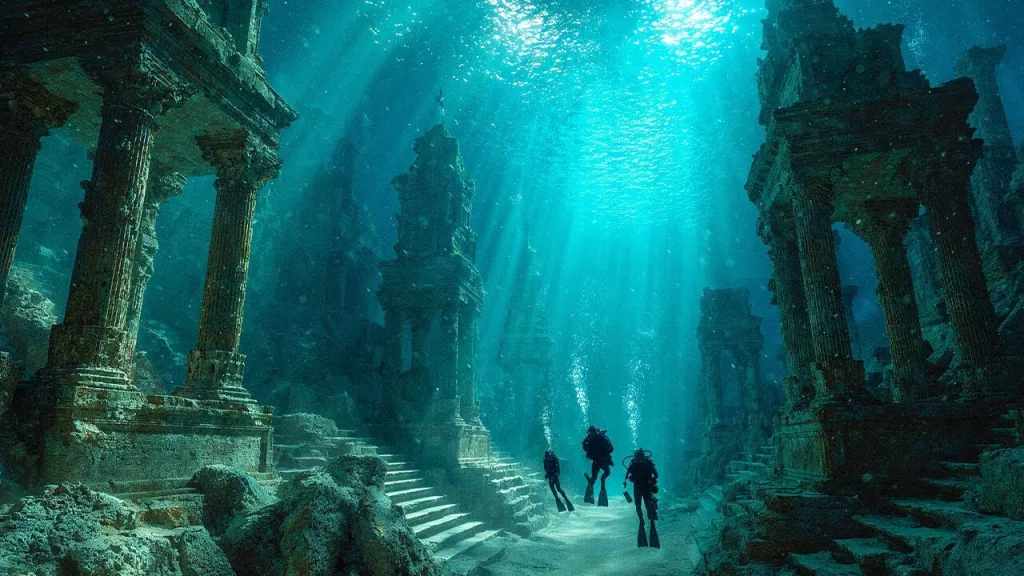
For decades, stories about lost cities beneath the ocean have captured human imagination.
From legends like Atlantis to modern underwater discoveries, the idea that entire civilizations could be hidden beneath the waves is both fascinating and mysterious.
But how much of it is real?
And how much is simply speculation?
Let’s take a closer look at some of the most intriguing underwater discoveries — and what science actually says about them.

The Discovery That Sparked Global Curiosity
In 2001, a team of researchers working off the western coast of Cuba made an unexpected observation.
Using sonar technology to scan the ocean floor — originally in search of shipwrecks and natural resources — they detected unusual formations more than 2,000 feet below the surface.
At first, the findings seemed ordinary.
But as the data came in, the shapes appeared increasingly structured.
Straight lines.
Symmetrical layouts.
Geometric patterns that didn’t immediately resemble natural formations.
This led to an intriguing question:
Could these be the remains of an ancient settlement?
Understanding What Sonar Really Shows
Before jumping to conclusions, it’s important to understand how sonar works.
Unlike cameras, sonar doesn’t capture detailed images.
Instead, it sends sound waves that bounce off objects and return signals. These signals are then translated into visual representations — often abstract, low-resolution outlines.
In other words, sonar can suggest shapes and structures, but it doesn’t provide definitive visual proof.
So while the formations appeared organized, their exact nature remained uncertain.
A Closer Look Using Remote Technology
To investigate further, the research team deployed a remotely operated underwater vehicle (ROV).
Unlike sonar, this device could capture actual video footage.
The images revealed large stone-like structures scattered across the seabed.
Some appeared rectangular.
Others seemed stacked or aligned in ways that suggested intentional placement.
To observers, the site resembled the outline of buildings or corridors — something that looked, at least visually, like an ancient settlement.
Why the Discovery Drew Attention
The idea of a submerged city naturally attracted global interest.
If confirmed, it could potentially reshape our understanding of early human civilizations in the Americas.
Some early interpretations suggested that the formations might be thousands of years old — possibly even predating well-known ancient cultures.
However, these interpretations were speculative and not supported by direct dating evidence at the time.
What the Scientific Community Said
As news of the discovery spread, many experts urged caution.
Several key questions were raised:
- Could the formations be natural geological structures?
- Was there any evidence of human activity, such as tools or carvings?
- How could such structures exist at such extreme depths?
One major challenge was the depth itself.
At over 2,000 feet below the surface, the site was far deeper than most known submerged cities.
For comparison, many verified underwater archaeological sites are found in relatively shallow waters — often less than 100 feet deep.
This difference raised doubts about whether the Cuban site could be linked to a human-built civilization.
The Depth Factor
Ocean depth plays a critical role in understanding underwater discoveries.
Sea levels have risen over time, especially since the end of the last Ice Age.
However, even accounting for these changes, a depth of over 2,000 feet is difficult to explain through known sea-level shifts alone.
Geological processes such as tectonic activity can cause land to sink, but such dramatic changes typically occur over very long periods.
This makes rapid submersion theories less likely, though not entirely impossible.

Natural vs. Man-Made Structures
One of the most important aspects of underwater archaeology is distinguishing between natural formations and human-made structures.
Nature is capable of creating surprisingly symmetrical patterns.
Rock formations shaped by erosion, sedimentation, and tectonic movement can sometimes resemble walls, steps, or even buildings.
Examples like the basalt columns of natural formations around the world demonstrate how geometric shapes can occur without human involvement.
Because of this, scientists require strong evidence — such as tools, inscriptions, or construction marks — before confirming human origin.
Why the Research Didn’t Continue
After the initial discovery and media attention, further exploration of the Cuban site slowed down.
There are several practical reasons for this:
- Deep-sea exploration is extremely expensive
- Specialized equipment is required
- Drilling and sampling at such depths is technically challenging
- Funding for long-term research is limited
Without additional data — especially physical samples — it becomes difficult to draw firm conclusions.
As a result, the site remains largely unexplored.
Another Perspective: Real Underwater Discoveries
While some underwater sites remain uncertain, others provide clear evidence of ancient human activity.
One notable example comes from North America.
The Lake Huron Discovery
In 2013, researchers studying the bottom of Lake Huron made an important find.
They recovered small fragments of obsidian — a volcanic glass used by ancient humans to make tools.
What made this discovery remarkable was the origin of the material.
The obsidian was traced back to central Oregon — nearly 4,000 kilometers away.
What This Means
This finding suggests that ancient people living in the region had access to long-distance trade networks.
It also confirms that humans were actively using and modifying this landscape thousands of years ago.
At the time, parts of the Great Lakes region were not underwater.
They were dry land used for hunting and travel.
As water levels rose, these areas became submerged, preserving traces of early human activity.
A Natural Time Capsule
Cold freshwater environments like Lake Huron can preserve organic materials exceptionally well.
Researchers have discovered:
- Ancient wooden structures
- Plant remains
- Stone tools
- Evidence of hunting systems
These findings provide valuable insights into life during the end of the Ice Age.
The Oldest Known Submerged City
Another well-documented site is Pavlopetri, located off the coast of Greece.
This ancient settlement is considered one of the oldest known submerged cities in the world.
Dating back around 5,000 years, Pavlopetri features:
- Streets
- Buildings
- Courtyards
- Burial sites
Unlike uncertain discoveries, Pavlopetri has been extensively studied and mapped using modern technology.
How It Became Submerged
Scientists believe that a combination of earthquakes and rising sea levels caused the city to sink.
This type of gradual environmental change is a well-understood process in geology and archaeology.
A Mysterious Formation Near Japan
Another frequently discussed site is the Yonaguni Monument near Japan.
This underwater structure features large, flat surfaces and sharp angles that resemble steps and terraces.
Some researchers believe it could be the remains of a human-made structure.
Others argue that it is a natural rock formation shaped by geological processes.
Why There’s Still Debate
The main reason for disagreement is the lack of definitive evidence.
While the structure looks unusual, it remains connected to the surrounding bedrock.
This suggests it may not have been built piece by piece, as most human structures are.
Until more concrete evidence is found, the debate continues.
Human History Beneath the Ocean
The idea of underwater civilizations is not entirely fictional.
Throughout history, many coastal settlements have been submerged due to:
- Rising sea levels
- Earthquakes
- Land subsidence
- Natural disasters
These events have created real underwater archaeological sites around the world.
Separating Myth from Reality
Stories like Atlantis continue to inspire exploration and curiosity.
However, it’s important to distinguish between myth and evidence-based science.
While some discoveries raise interesting questions, they don’t always lead to definitive conclusions.
Why the Ocean Still Holds Secrets
More than 80% of the ocean remains unexplored.
This means there are still countless discoveries waiting to be made.
Advancements in technology — such as improved sonar, robotics, and deep-sea exploration tools — are gradually helping scientists learn more.
A Balanced Perspective
It’s natural to feel intrigued by the possibility of lost civilizations.
But scientific progress depends on careful investigation, evidence, and verification.
In many cases, what initially appears mysterious may have a natural explanation.
In others, it may take years — or even decades — to fully understand what has been found.
Final Thoughts
The story of the Cuban underwater formations remains unresolved.
It may represent a natural geological structure.
Or it could point to something more complex that requires further study.
What we do know is this:
The ocean continues to challenge our understanding of history.
And sometimes, the most fascinating discoveries are not the answers themselves — but the questions they leave behind