At first, there was nothing remarkable about the dive.
The water was calm. Visibility was decent. The current was low — ideal conditions for a routine underwater survey. For the team of experienced divers, it was just another assignment, the kind they had completed dozens of times before.

No one expected the discovery that would follow.
And certainly not the story that would come with it.
A Shape That Didn’t Belong
The team moved methodically across the seabed, scanning for anything out of place — debris, remnants of old wreckage, or environmental changes worth documenting.
That’s when one of them noticed it.
A shape.
At first, it was just an outline in the distance. Slightly darker than the surrounding seabed. Easy to miss if you weren’t looking closely.
But as they approached, the shape became clearer.
It wasn’t coral.
It wasn’t rock.
It was something unmistakably man-made.
A car.
An Unlikely Discovery
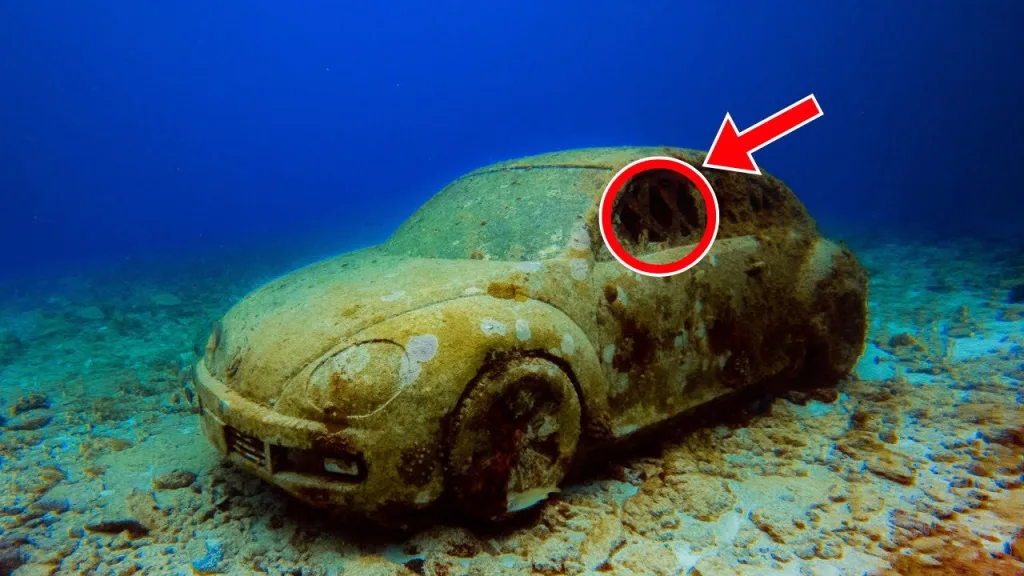
The vehicle rested quietly on the ocean floor, partially settled into the sand. Its outline was still intact — the curve of the roof, the defined edges of the hood, even the suggestion of door frames.
It didn’t look like typical wreckage.
There were no signs of a crash. No scattered debris. No structural collapse.
Instead, it looked… placed.
As if it had been lowered there carefully, rather than lost.
The team instinctively slowed their movements. Underwater, communication is minimal, but experienced divers don’t need words to sense when something feels unusual.
They circled the vehicle, observing from different angles.
The seabed around it appeared slightly disturbed — not chaotic, but different enough to suggest that the area had been altered at some point in the past.
Everything else nearby remained undisturbed.
That contrast raised questions.
First Contact
One diver, Jim, moved closer.
He directed his light across the surface of the vehicle. Marine growth covered parts of it — as expected after years underwater — but something stood out.
Certain sections looked… preserved.
Too defined. Too intact.
Curious, Jim reached out and touched the metal.
Nothing shifted.
No loose panels. No fragile collapse.
Just stillness.
A Simple Plan… At First
The initial decision was straightforward.
Attach a line.
Bring the vehicle up.
Document it properly.
The team had recovered objects before. While a submerged car was unusual, it wasn’t unheard of.
They worked together to secure a lifting strap beneath the frame.
Everything proceeded as expected — until they attempted to lift it.
The Weight Problem
The line tightened.
The team applied steady pressure.
But the car didn’t move.
Not even slightly.
At first, they assumed it was simply heavier than anticipated. Waterlogged materials, sediment buildup — those factors could significantly increase weight.
They adjusted their positions and tried again.
Still nothing.
The strap strained slightly under tension.
Then, slowly, the car shifted — just a few inches.
But the resistance felt unusual.
It didn’t behave like an object stuck in sand.
It felt anchored.
Something Beneath the Surface
Jim moved toward the front of the vehicle, scanning with his light.
That’s when he saw it.
A cable.
Thin, darkened by time, partially hidden beneath layers of sand and marine growth.
It extended from underneath the car and disappeared into the seabed.
This wasn’t natural.
Someone had attached it.

A Pause for Caution
Jim signaled the team to stop.
They hovered silently, watching the cable disappear into the sand like it had been there for years — maybe decades.
Questions began to form.
Why would a car be anchored underwater?
If it were simply discarded, there would be no reason to secure it like this.
And if it were intentional…
Then what was the purpose?
Uncovering the Anchor
Instead of cutting the cable, the team decided to investigate.
Carefully.
They used their hands to move the sand aside, working slowly to avoid disturbing whatever lay beneath.
Inch by inch, the cable was revealed.
It led to a steel ring.
And that ring was fixed into something solid below the seabed.
Not rock.
Not natural.
Something constructed.
A Decision to Proceed
At this point, the team had a choice.
Leave it undisturbed.
Or continue.
Curiosity — balanced with caution — led them forward.
They adjusted their equipment and prepared for a controlled lift.
Breaking Free
This time, the lift was gradual.
Small increments.
Careful coordination.
The car began to rise — slowly, almost reluctantly.
The cable held for a moment.
Then, with a subtle release, the anchor gave way.
A cloud of silt expanded into the water, temporarily obscuring visibility.
Within that cloud, something glinted briefly.
Metal.
A plate, perhaps.
But the team stayed focused.
The priority was bringing the vehicle safely to the surface.
The Surface Reveal
Once secured on the boat, the vehicle looked even more unusual.
Water streamed off its surface in thin, steady lines.
Marine growth covered much of it, but the structure remained surprisingly intact.
There was no significant collapse.
No obvious damage.
It didn’t resemble a typical wreck.
It resembled something built to endure.
An Unexpected Detail
Jim approached the driver’s side.
He reached for the handle — more out of instinct than expectation.
It moved.
Just slightly.
That alone was enough to pause everyone.
He tried again, more carefully this time.
The door opened a fraction.
And something unexpected happened.
Air escaped.
Not bubbles from water displacement — but trapped air.
Along with it came a faint scent.
Dry.
Stale.
Completely unlike seawater.
Inside the Vehicle
The door opened enough to reveal the interior.
But it wasn’t what anyone expected.
Instead of seats or a dashboard, there was something else.
A chest.
Positioned where nothing should have been.
And it appeared… dry.
A Preserved Secret
Carefully, the team removed the chest.
Despite being submerged for what must have been decades, its condition suggested it had been sealed effectively.
There were carvings on its surface.
Names.
Initials.
A date.
Old, but still legible.
Opening the Chest
When the lid was finally opened, a small amount of trapped air escaped.
Inside, there were items carefully arranged and preserved.
Letters.
Photographs.
Documents.
All protected from the surrounding water.
A Story Begins to Emerge
The photographs showed a young man in uniform.
A woman standing beside him.
And, in some images, a car — identical in shape to the one recovered.
The letters were handwritten.
Detailed.
Personal.
They spoke of time, distance, and uncertainty.
Of promises made during difficult circumstances.
A Message Across Time
One line appeared repeatedly throughout the letters:
“If I don’t come back, this will.”
It became clear that the car was never meant to be just a vehicle.
It was a container.
A carefully constructed archive.
Reconstructing the Past
Further investigation revealed more context.
The man in the photographs was a soldier stationed near the coast during a time of conflict.
His work involved salvage operations — recovering materials from wrecks and submerged equipment.
At some point, he had repurposed a car.
Not for transportation.
But for preservation.
Engineering Something Unusual
The vehicle had been modified.
Hollowed.
Reinforced.
Sealed.
Designed to withstand pressure, time, and exposure.
It wasn’t accidental.
It was intentional.
A Final Act
When the soldier was called away, he made a decision.
He anchored the car to the seabed.
Secured it in place.
Left it where it would remain undisturbed.
The final photograph confirmed it.
It showed the car being lowered into the water.
The soldier standing nearby.
Watching.
An Unfinished Delivery
Historical records later confirmed what the letters suggested.
The soldier never returned.
He was declared lost at sea.
The letters he wrote were never delivered.
Until now.
A Reunion Decades Later
When the discovery was documented, efforts were made to locate surviving family members.
Eventually, they were found.
Older now.
But still connected to the past through memory.
When they saw the letters, the handwriting was immediately recognizable.
What had been lost to time had been returned.
More Than a Discovery
For the divers, the experience went beyond a routine recovery.
It became something else entirely.
A reminder of how objects can carry meaning far beyond their physical form.
And how stories can endure, even in the most unexpected places.
Why It Matters
Not every discovery is about value or rarity.
Sometimes, it’s about connection.
About preserving something that would otherwise be forgotten.
In this case, a simple object — a car — became a bridge between past and present.
Final Reflection
The ocean holds countless stories.
Most remain hidden.
Some are lost forever.
But occasionally, something resurfaces.
Not by accident.
But because someone, long ago, intended it to.
And when it does, it reminds us that even across decades, even beneath layers of time and distance…
Some messages still find their way home.