The story of the Roman Empire is one of the most fascinating narratives in human history, a tale of ambition, innovation, power, and eventual decline. From a small city-state on the banks of the Tiber River to a vast empire stretching across three continents, Rome shaped the political, cultural, and legal foundations of the modern world. The rise and fall of the Roman Empire is not just a historical account; it is a powerful lesson in how civilizations grow, flourish, and collapse.

The Rise of Rome: From City-State to Superpower
Rome began as a modest settlement in central Italy around the 8th century BCE. According to legend, it was founded in 753 BCE, but its real strength lay in discipline, organization, and strategy rather than in myth. Early Roman society was built on strong civic values, military training, and a deep sense of loyalty to the state.
During the Roman Republic, Rome expanded through alliances, wars, and shrewd diplomacy. The Roman army became one of the most powerful fighting forces in history, known for its discipline, engineering skills, and tactical innovation. Rome conquered neighboring regions and gradually extended its influence across Italy, North Africa, and parts of Europe.
The transformation from republic to empire began with political instability and internal power struggles. Figures like Julius Caesar played a crucial role in this shift. His assassination in 44 BCE triggered a series of civil wars, ultimately leading to the rise of the first emperor, Augustus, in 27 BCE. This marked the official beginning of the Roman Empire.
The Golden Age of the Roman Empire
Under Augustus and his successors, Rome entered a long period of stability and prosperity known as the Pax Romana (Roman Peace). This era lasted nearly 200 years and represented the peak of Roman power and influence.
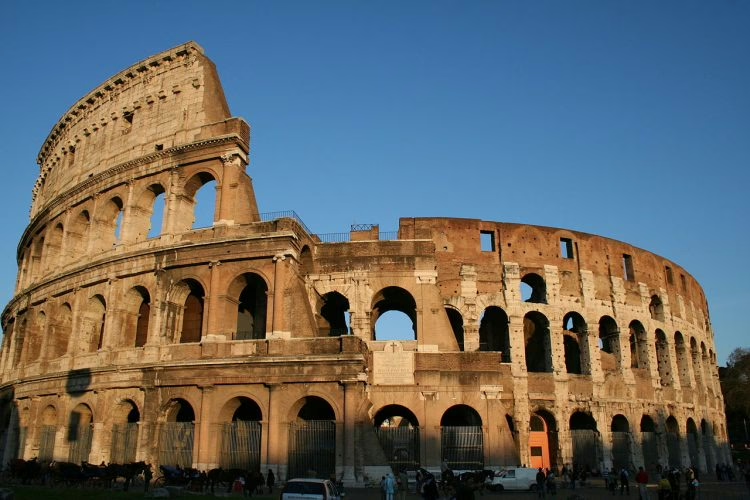
At its height, the empire stretched from Britain in the west to the Middle East in the east, and from Northern Europe to North Africa. Major cities like Rome, Alexandria, and Antioch became centers of trade, culture, and learning. Roads, aqueducts, bridges, and public buildings transformed urban life and connected distant provinces.
Roman law, governance systems, and architecture laid the foundation for many modern institutions. Latin became the language of administration, and Roman cultural values spread across Europe. The empire was not just a military power—it was a civilization that shaped art, politics, engineering, and philosophy.
Internal Weaknesses and Growing Challenges
Despite its greatness, the Roman Empire was not immune to problems. Over time, internal corruption, political instability, and economic strain weakened the system. Emperors were often chosen through violence rather than merit, leading to frequent coups and civil wars.
The empire also became too large to govern effectively. Managing vast territories required enormous resources, complex administration, and constant military defense. Heavy taxation burdened citizens, while wealth became increasingly concentrated among the elite.
In the 3rd century CE, Rome faced serious crises—economic inflation, declining trade, and weakened military discipline. Although reforms by emperors like Constantine the Great temporarily stabilized the empire, the underlying problems remained unresolved.
External Threats and the Pressure of Invasions
While internal decay weakened Rome from within, external threats accelerated its decline. Barbarian tribes such as the Visigoths, Vandals, and Huns began pushing into Roman territories. The Roman military, once unbeatable, struggled to defend its borders.
The sack of Rome by the Visigoths in 410 CE shocked the ancient world and symbolized the empire’s vulnerability. Repeated invasions, combined with economic collapse and political chaos, made recovery increasingly difficult.
In 476 CE, the Western Roman Empire officially fell when the last emperor was deposed—a moment often marked as the end of ancient Rome. This event, known as the Fall of the Western Roman Empire, did not happen overnight but was the result of centuries of gradual decline.
The Eastern Roman Empire and Rome’s Legacy
While the Western Roman Empire collapsed, the Eastern Roman Empire—also known as the Byzantine Empire—continued to thrive for nearly another thousand years, with its capital in Constantinople. Roman traditions, laws, and culture survived and evolved in this eastern half of the empire.
The legacy of Rome is still visible today. Modern legal systems, government structures, architecture, and languages all carry Roman influence. Concepts such as citizenship, republics, and written law trace their roots to Roman civilization.

Conclusion
The rise and fall of the Roman Empire is a powerful reminder that even the greatest civilizations are not permanent. Rome rose through discipline, unity, innovation, and strong leadership. It fell due to internal division, corruption, economic pressure, and external threats.
Yet, Rome never truly disappeared. Its ideas, systems, and culture live on in the modern world, shaping nations, laws, and societies across the globe. The Roman Empire may have fallen, but its influence remains eternal—proving that history does not end with collapse, but transforms into legacy.