In the vast, unpredictable waters of the Pacific Ocean, a humble fisherman named Miguel Rodriguez lived a life defined by routine, resilience, and uncertainty. In a remote corner of the Philippines, far from the noise of cities and modern convenience, Miguel’s world revolved entirely around the sea. It was both his provider and his greatest threat.
Every morning before sunrise, Miguel would push his small wooden banca into the calm waters, guided only by instinct and years of experience. Like generations before him, he relied on traditional fishing methods, simple tools, and a deep understanding of tides and weather patterns. There were no guarantees. Some days brought in enough fish to support his family and sell a little extra at the village market. Other days returned him home with empty nets and heavy thoughts.
Life in his village was simple but harsh. Electricity was unreliable, income was unstable, and survival depended heavily on nature’s mood. The people were close-knit, sharing both hardships and small victories. Yet despite the struggles, there was dignity in their way of life.

However, one force loomed over everything—the typhoon season.
The Silent Aftermath of Powerful Storms
The Philippines sits in one of the most active storm belts in the world. Every year, powerful typhoons sweep across the islands, bringing destruction in their wake. For fishermen like Miguel, these storms were terrifying. They could destroy boats, flatten homes, and wipe out entire communities within hours.
But beyond the visible destruction, there was another, lesser-known consequence of these storms—lost cargo.
Across the oceans, massive container ships transport goods globally. During violent weather, these ships can lose containers overboard. Thousands of these steel boxes fall into the sea every year. While some sink immediately, others float, drifting across vast distances carried by ocean currents.
These containers become silent travelers—metal ghosts floating across the ocean with no clear destination. Occasionally, after weeks or even months, one might wash ashore in the most unexpected places.
And on one fateful day, one of those containers found its way into Miguel’s life.
The Discovery That Changed Everything
Miguel had ventured farther than usual that day. His regular fishing spots had not been productive, and desperation pushed him toward a more dangerous area known for its reefs. As he navigated carefully along a remote shoreline, something unusual caught his eye.

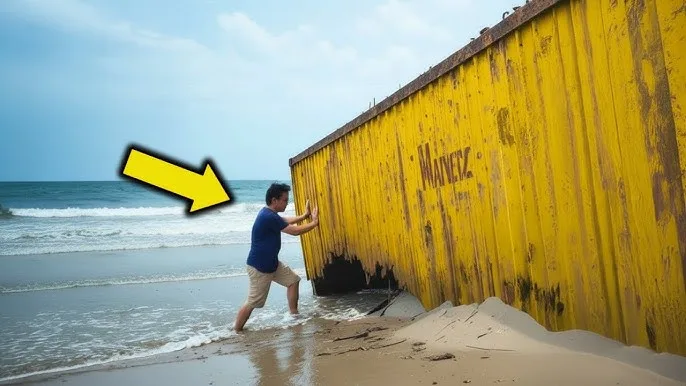
At first, it looked like a strange shadow against the bright sand. But as he moved closer, the shape became clear—a massive shipping container resting on the shore of an uninhabited island.
It didn’t belong there.
The container was rusted, covered in barnacles, and partially buried in the sand. It had clearly been at sea for a long time. There were no clear markings left, no visible identification. Just a giant steel box, abandoned by the world.
Miguel stepped onto the shore cautiously, his heart beating faster. He had heard stories of strange things washing ashore after storms, but he had never seen anything like this.
Curiosity took over.
Breaking Into the Unknown
The container’s heavy doors were sealed shut with a thick, rusted padlock. Miguel stood there for a moment, weighing his options. He was not a wealthy man. The thought of valuable goods inside—electronics, machinery, or something rare—crossed his mind.
This could change everything.
With nothing but a machete and a large stone, Miguel began the difficult task of breaking the lock. Under the intense heat of the tropical sun, he struck the corroded metal again and again. The sound echoed across the empty shoreline.
Time passed slowly.
Finally, with a sharp crack, the rusted lock gave way.
Miguel hesitated for a moment before pulling open the heavy doors. They creaked loudly, resisting at first, then slowly opening to reveal the contents inside.
What he saw surprised him.
A Treasure Unlike Any Other
Inside the container were stacks of water-damaged cardboard boxes, piled from floor to ceiling. There were no obvious signs of expensive electronics or machinery. For a brief moment, Miguel felt a sense of disappointment.
But curiosity pushed him forward.
He opened one of the boxes carefully, tearing through the damp cardboard. Inside, he found sealed plastic packages. Through the clear wrapping, he could see long, dark, oily pods.
Vanilla beans.
Thousands upon thousands of them.
At first, the discovery seemed underwhelming. It wasn’t gold. It wasn’t jewelry. It wasn’t something immediately recognizable as “treasure.”
But Miguel knew enough to understand one thing—vanilla was valuable.
Very valuable.
Why Vanilla Is Worth More Than It Seems
Vanilla is one of the most expensive spices in the world, second only to saffron. Its high value comes from the incredible effort required to produce it.
The vanilla plant is an orchid, and its flowers bloom for only a single day. During that short window, each flower must be pollinated by hand. If it is missed, no bean will grow. This makes the process extremely labor-intensive.
After pollination, the beans take months to mature. Even then, they are not ready for use. They must go through a long curing process involving drying, sweating, and careful handling to develop their signature aroma and flavor.
This entire process can take several months to complete.
That is why high-quality vanilla is so rare—and so expensive.
Miguel had unknowingly opened a floating treasure chest.
The Journey Back to the Village
Realizing the potential value of his discovery, Miguel acted quickly. His small boat could not carry everything, so he loaded as many boxes as possible and began the journey back to his village.
The trip felt longer than usual.
His mind raced with possibilities, questions, and concerns. What if the cargo belonged to someone? What if he was not allowed to keep it? What if it was worthless after all?
When he finally reached his village, word spread rapidly. The entire community gathered to see what he had found. Excitement filled the air.
But Miguel knew he had to do the right thing.
He reported the discovery to local authorities.
The Investigation and Legal Twist
Maritime officials began investigating the container. Using faint serial numbers still visible on the metal, they traced its origin through shipping records.
The container had been lost years earlier during a powerful typhoon.
But the most surprising discovery came next.
No insurance claim had ever been filed for the lost cargo.
Under maritime salvage laws, unclaimed cargo can legally become the property of the person who finds it—after a waiting period.
No owner came forward.
Eventually, a court ruling declared Miguel Rodriguez the rightful owner of the entire shipment.
His life changed overnight.
From Survival to Opportunity
Experts were brought in to evaluate the vanilla beans. Despite spending a long time at sea, the beans had been vacuum-sealed and remained in excellent condition.
The valuation was staggering.
For a man who had lived day to day, the discovery was beyond imagination. It was enough to secure his family’s future and change his circumstances completely.
But Miguel didn’t stop there.
Lifting an Entire Community
Instead of keeping everything for himself, Miguel chose to invest in his village. He understood the struggles of his fellow fishermen because he had lived them.
He purchased larger, safer fishing boats equipped with better tools. He created job opportunities for others in the village, ensuring stable income for multiple families.
What started as a single discovery turned into a community transformation.
The village began to grow. Living conditions improved. Children had better access to education. Families experienced stability for the first time in years.
Miguel’s success became everyone’s success.
A Story of Chance, Honesty, and Impact
Miguel Rodriguez’s story is not just about luck. It is about what happens after luck appears.
He could have hidden the discovery. He could have kept everything for himself. But instead, he chose honesty, responsibility, and community.
The ocean, which had always been a source of struggle, became the source of opportunity.
It delivered something unexpected—something that had been lost, forgotten, and carried across the world by chance.
The Ocean’s Hidden Stories
The sea holds countless mysteries. Lost cargo, hidden wrecks, and forgotten objects lie beneath its surface or drift across its waters. Most are never found. Some are discovered too late.
But occasionally, the ocean returns something in the most unexpected way.
Miguel’s story reminds us that not all treasures shine. Some come in forms we don’t immediately recognize. Some require patience and understanding to reveal their true value.
Final Thoughts
In the end, the story of the lost container is more than just a tale of fortune. It is a reminder that life can change in an instant—but what truly matters is what we choose to do with that change.
Miguel Rodriguez found a container.
But what he really found was opportunity.
And by sharing it, he turned a moment of luck into a legacy.